The power crunch of silicon AI
Why exponentially growing AI workloads create energy, cooling and memory-movement problems.
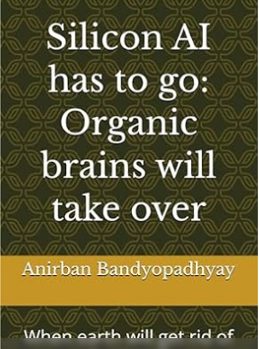
Artificial Brains Will Take Over
A book about the energy and architectural limits of conventional silicon AI, and why future intelligence may require processors that work with geometry, hierarchy, self-organization and organic brain-like matter.
A future intelligence may not be written line by line. It may have to grow as an architecture.Research / book proposition
The central problem is not simply whether artificial intelligence can become more powerful. It is whether the physical architecture underneath AI can keep scaling without an unsustainable increase in power, memory movement and computational complexity.
This book argues for a different direction: intelligence should not be forced to memorize and serially manipulate every piece of data. A future processor should be able to transform one geometry into another, embed one geometry inside another, and let structure itself carry part of the computation.
As complexity grows, writing explicit code for every possible transformation becomes increasingly difficult. Brain-like and organic architectures suggest another route: allow matter, geometry, rhythm and hierarchy to participate in processing rather than treating them as passive containers for software.
Why exponentially growing AI workloads create energy, cooling and memory-movement problems.
How nested and transforming geometries could become computational objects rather than merely data to be encoded.
Why soft matter, supramolecular gels and brain-like architectures may offer a different physical basis for intelligence.
When artificial intelligence could genuinely approach or exceed particular human capabilities, and what physical conditions would make that possible.
Why increasingly complex intelligence may require architectures that are not reducible to a fixed linear circuit.
These terms describe subjects discussed on this page and across Anirban Bandyopadhyay's research and books.