Artificial brain from organic matter
Why supramolecular and gel-like systems are candidates for brain-like hardware.
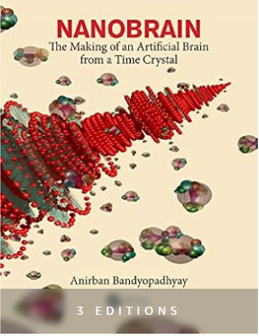
The Making of an Artificial Brain from a Time Crystal
An account of the long research journey toward an artificial brain built from organic matter, resonances, nested temporal architecture, time crystals, microtubule-related questions and unconventional computation.
Instead of asking where the next prime hides, ask what architecture is being built while integers organize themselves.Research / book proposition
Nanobrain grew from a long attempt to build an artificial brain physically rather than simulate one only in software. The research journey began in Japan at a time when circuit-based descriptions dominated most discussions of computation and brain-inspired engineering.
The book challenges the assumption that a brain is fundamentally a linear circuit. Biological function is shaped not only by local transmission but also by projection across scales: structures within structures, rhythms within rhythms, and influences that arrive from both local and higher levels of organization.
A major part of the book asks a different question about prime numbers. Instead of asking only where the next prime occurs, it asks how integers self-organize into patterns that generate further patterns. This change in question motivates the Phase Prime Metric, nested clocks and the broader proposal of a Self-Operating Mathematical Universe.
The same artificial-brain research program extends beyond computation into medical nanotechnology: brain-model ideas, molecular machines, self-operating nanorobot concepts and cancer-treatment directions are treated as part of a wider attempt to build physical systems that sense, decide and act.
Why supramolecular and gel-like systems are candidates for brain-like hardware.
How nested temporal architecture and resonance can provide a physical language for organization.
How biological structures and frequency-dependent behavior motivate questions beyond classical neural-circuit models.
A proposal to study how integer and prime structures generate evolving geometric and temporal patterns rather than treating primes only as an ordered list.
A framework in which mathematical structure is studied as an active generative architecture capable of producing new structure, time and organization.
How the artificial-brain program connects to molecular machines, self-operating therapeutic systems and cancer-treatment concepts.
These terms describe subjects discussed on this page and across Anirban Bandyopadhyay's research and books.